
OTA Students Embrace Progressive Practices
February 19, 2026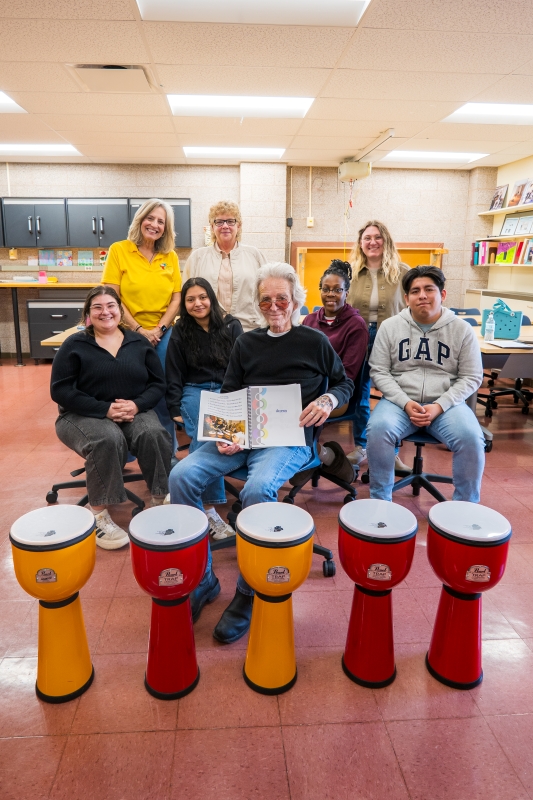
SUNY Orange Occupational Therapy Assistant students are gaining hands-on experience far beyond traditional clinical settings, bringing play-based, community-centered occupational therapy directly to children and families across Orange County.
Jeremy Camacho of New Windsor, Lissette Delgado of Newburgh, and Danielle Dumas of Newburgh, all Newburgh Free Academy alumni, and Laura Kahle of Pine Bush, a Pine Bush High School graduate, are participating in a non-traditional Level II fieldwork experience that places them at the heart of community programming.
Each student arrived at the OTA program through different academic paths. Camacho, Delgado, and Dumas began in radiologic technology or nursing before discovering occupational therapy through advisors and mentors. Kahle came from a background in environmental studies and product development, with interests in nature-based and horticulture therapy, as well as animal-assisted interventions. Despite their different starting points, each found occupational therapy to be a better fit.
“I didn’t even know this was an option at first,” Delgado said. “Once I learned what OT really was, I knew this was where I belonged. It forces you to think, adapt, and really connect with people.”
A centerpiece of their fieldwork takes place during weekly Tuesday sessions at the Newburgh Armory. The open, community-wide program invites families with children from infancy through age five to participate in 90 minutes of uninterrupted, screen-free play. Stations are loosely structured and include music, movement, pretend play, sensory activities, and fine and gross motor challenges. The focus is on getting parents actively involved alongside their children.
“We’re not just setting up activities and stepping back,” Kahle said. “We explain the why behind everything so parents can take these ideas home and keep supporting their child’s development.”
Attendance often reaches 50 to 60 children and caregivers, filling much of the gymnasium. For the students, that means constant observation, quick decision-making, and flexibility. They must support individual children while keeping an eye on the larger group, adapting activities in real time to meet a wide range of developmental needs.
“Sometimes you’re working with one child, and other times you just sit down, and kids start coming to you,” Dumas said. “On the parent side, you’re focused on your own child. On the OT side, you’re thinking about everyone at once.”
The students collaborate with community partners such as Orange County Early Intervention Services and TRAP Learning, which provides music-based enrichment every other week. TRAP activities allow the students to incorporate rhythm, color, movement, and sensory input using drums and other instruments, all of which can be adapted for different abilities and ages.
Founder of The Rhythmic Arts Project (TRAP) Learning, Eddie Tuduri, said the organization’s work is rooted in compassion and connection. “I hope our facilitators remember and take forward that when we truly look into what The Rhythmic Arts Project is, we find a much deeper rhyme and rhythm in its essence. We care deeply for the participants, young and old. The prerequisites for facilitation are compassion, love, and understanding. Charity has a deeper meaning as well when it is referred to as charity of the heart.”
Debbie Major, executive assistant at TRAP Learning, said the approach has had a lasting personal and professional impact. “As long as the organization has been in existence, Eddie has worked directly with the students, staff, and families. He trained me after I bought the kit for my non-profit Zylofone Studios, so I am also working in the same capacity. Using drums to facilitate communication, socialization, and learning styles has influenced me as a teacher, parent, and musician.”
Academic Fieldwork Coordinator Tarah Miller, MPS, COTA/L, said the experience reflects a broader vision for occupational therapy education and access. “I am so proud of our second-year students. They have stepped beyond traditional settings, planting the seeds of occupational therapy where services don’t currently exist. Through the lens of health promotion and using principles of teaching and learning, they are leading with self-determination, thoughtful problem solving, and are developing a strong therapeutic use of self. Their goal is to increase access and awareness of the broad scope of OT services in our local community, advancing occupational justice while refining their skills as emerging occupational therapy practitioners.”
In addition to the Armory sessions, the students rotate through placements at Patty Cake Playhouse in Newburgh, Middletown Day Nursery, The Learning Experience in Middletown, and afternoon programming with BRIDGES students. Fridays are dedicated to planning, supervision, and reflection, where students review upcoming sessions, modify activities, and document their growth through reflective journals.
Compared to traditional rehabilitation-based fieldwork, the non-traditional experience requires a different mindset.
“In rehab, it’s very medical and structured,” Dumas said. “This feels more like going with the flow, but there’s so much intention behind it. It’s health promotion in action.”
Camacho said the experience has pushed him to be more confident and engaged.
“It’s more hands-on, more active, and more personal,” he said. “I’ve grown a lot, not just clinically, but as a person. I’m even using Spanish more with families, which has been really meaningful.”
For several students, the fieldwork has shifted their career outlook. Delgado noted that working with young children was new territory for her, but one she now embraces.
“I wasn’t exposed to pediatrics before this,” she said. “Now I feel comfortable, confident, and excited about it. Seeing development by age, and how much kids change year to year, is incredible.”
Kahle said the experience confirmed her interest in community-based occupational therapy.
“This showed me the bigger picture,” she said. “It’s not just about the kids. It’s about the families, the relationships, and the community. Parents are meeting each other, kids are accessing things they don’t have at home, and we’re right there supporting all of it.”
As the students prepare for their next Level II fieldwork rotation this spring, the impact of the experience is clear in their confidence and professional growth.
“Each time we have a supervision session, I observe changes and clear moments of growth in each of them as a result of this non-traditional Level II fieldwork experience,” said OTA Department Chair Donna Frazier, MA, OTR/L, CAPS. “It is deeply gratifying to witness their increasing confidence, clinical reasoning, and professional identity emerge as they integrate theory into practice and develop as future occupational therapy practitioners.”
For these SUNY Orange OTA students, non-traditional fieldwork is more than an alternative placement. It is a dynamic, immersive experience that is shaping how they see occupational therapy, community engagement, and their future roles as healthcare professionals.
To learn more about SUNY Orange’s Occupational Therapy Assistant program and other academic offerings, visit sunyorange.edu or explore how the College connects learning with real-world community impact.
Photo (Left to Right Row 1) Laura Kahle, Lisette Delgado, Eddie Tuduri (TRAP), Danielle Dumas, Jeremy Camacho (Left to Right Row 2) Debbie Major (TRAP), Donna Frazier OTA department chair, Monika Williams OTA department secretary
Your Path Begins Here
